
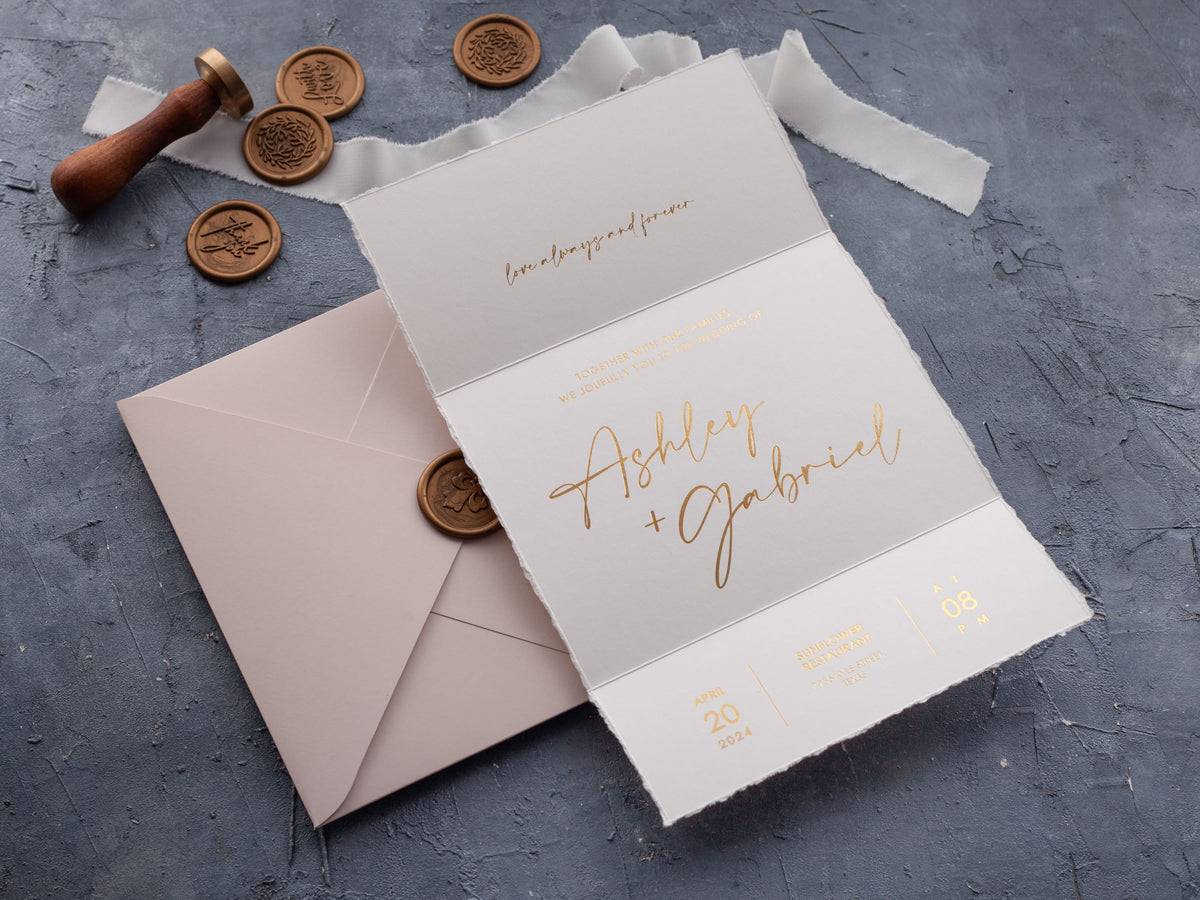
A trifold invitation gives you more room than a flat card, but every panel still needs a clear job. When the wording follows the way a guest naturally opens the piece, names, ceremony details, travel notes, and response instructions are easier to find.
This guide shows you what to place on each panel, how to keep the reading order obvious, and when a folded format is the best fit for your celebration.
In short: Put the couple's names and celebration purpose on the front, essential ceremony details on the first inside panel, and supporting information such as reception timing, travel notes, RSVP instructions, and your wedding website across the remaining panels. Keep each panel focused so guests can scan the invitation in a natural sequence.
What Information Belongs on the Front of a Trifold Wedding Invitation?
The front panel should introduce the celebration, not explain the full day. Use the couple's names as the main focal point, then add a short line such as “Together with their families” or “Invite you to celebrate their marriage” if it suits the design. A concise date can appear here, but it does not need to repeat every detail printed inside.
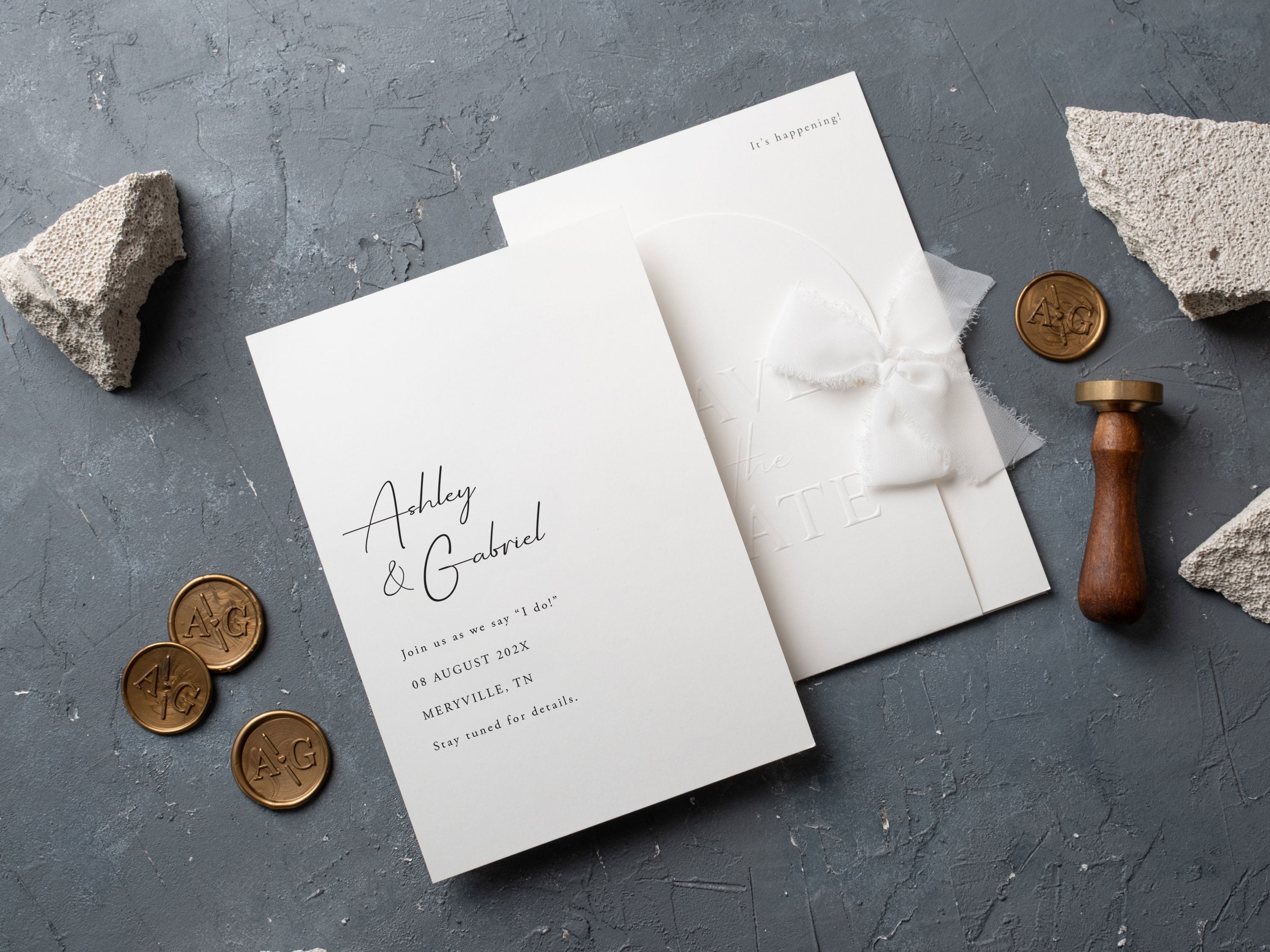
Keep the front visually calm. One clear type hierarchy makes the invitation feel intentional and gives guests a simple starting point. Decorative script can work well for the names, while a clean serif or sans-serif font can handle the supporting line. If the design includes foil, a crest, or a wax-seal effect, let that detail frame the wording rather than compete with it.
The fold orientation also matters. Before approving the proof, confirm which panel is visible when the invitation is closed and where the opening edge sits. Viewing active trifold wedding invitations can help you compare closed presentations before you finalize the first line.
What Should Guests See When They Open the First Panel?
The first inside panel should answer the questions guests need answered immediately: who is getting married, when the ceremony begins, and where it takes place. Write the date in a consistent style, include the start time, and give the venue name and city. Add the full street address when it is helpful, especially if the location may be unfamiliar.
If your ceremony and reception share one venue, a short line such as “Reception to follow” may be enough. If they take place at different locations, keep the ceremony panel focused and move reception details to the next panel. This prevents the most important information from becoming buried in a dense block.
Think of the invitation as a sequence: cover, ceremony, celebration, practical details, then response. That order mirrors the guest's planning process. A fully open design also lets you check whether headings, text alignment, and folds make the intended sequence clear.

Where Should Reception, Travel, and Accommodation Details Go?
Use the middle or next inside panel for reception information. Include the venue, start time, dress code, and a brief note if transportation is provided. When the reception follows at the ceremony location, you can use the extra space for a welcome event, farewell brunch, or a simple timeline instead.
Travel and accommodation details belong on their own panel when they are important to most guests. Keep the wording practical: hotel name, booking deadline, reservation code, nearest airport, and a short transportation note. A wedding website can carry changing or lengthy information, so the printed panel only needs the details guests must notice first.
Destination weddings often benefit most from this structure. The main invitation can remain formal while a separate panel handles itinerary and travel guidance. If your event needs several distinct sections, compare gatefold wedding invitations as well as trifold designs; the opening experience and usable panel space are different even when both formats feel layered.
How Should You Place RSVP Instructions or a QR Code?
Place the response instructions near the end of the reading sequence, usually on the final inside panel or back panel. State the RSVP deadline clearly and tell guests exactly how to respond. For an online response, use a short wedding website address, a QR code, or both. The written URL gives guests a backup if a phone cannot scan the code.
Leave enough clear space around a QR code so surrounding artwork, text, or foil does not interfere with scanning. Do not place it across a fold, near a trim line, or on a highly reflective surface without testing it. Scan the final proof from more than one phone and under normal indoor lighting.
If you use a traditional reply card, the invitation can simply state the deadline and direct guests to the enclosed card. Avoid repeating response instructions in several panels. One clear call to action is easier to follow and reduces the chance that guests use the wrong method.
How Much Wording Fits Comfortably on Each Panel?
Give each panel one primary purpose and use short sections rather than a continuous paragraph. Names and event headings need generous space; addresses, dress codes, and short instructions can use a smaller supporting style. A panel that contains several unrelated messages will feel crowded even when every sentence is technically short.
Start by writing the essential information in plain text before fitting it into a design. Remove repeated phrases, shorten directions that can live on your website, and use descriptive headings such as “Reception,” “Travel,” and “RSVP.” White space is functional: it separates topics and helps guests notice dates, times, and locations.
Always review a proof at the invitation's real size. A layout that looks spacious on a large screen may feel tight in print. Check the smallest text, the distance from folds, and the contrast between wording and background. If content still feels compressed, move secondary details online rather than reducing the type until it becomes difficult to read.
How Can You Keep a Three-Panel Invitation Easy to Follow?
Use a consistent hierarchy across all panels. Primary headings should look alike, body details should share one readable typeface, and dates or locations should not change style without a reason. Small visual cues, such as matching headings or a simple timeline, can connect the panels without adding clutter.
Ask someone who has not seen the draft to open the proof and describe the reading order. If they skip a panel or cannot find the response deadline, adjust the placement before production. The fold itself should guide the reader; arrows and long instructions should not be necessary.
A trifold is ideal when you need several organized information groups. A simpler folded wedding invitation may be better when you have one main event and only a small amount of supporting detail. Compare both formats with your final wording, not sample text, so the design matches the real amount of information.

What Are the Most Common Trifold Invitation Wording Questions?
What goes on the front panel of a trifold wedding invitation?
Use the couple's names, the celebration type, and a concise date or opening line. Keep the front visually simple so it introduces the invitation without repeating every event detail.
Where should the ceremony time and venue appear?
Put the ceremony date, time, and venue on the first inside panel guests see after opening the invitation. This keeps the most important information immediately accessible.
Can a trifold invitation include reception details?
Yes. A separate panel can hold the reception venue, start time, dress code, and any note explaining whether the reception follows at the same location.
Where should RSVP information go on a trifold invitation?
Place RSVP instructions on the final inside panel or back panel, where guests naturally finish reading. Include a deadline and a short URL or QR code when appropriate.
How much text should each panel contain?
Give each panel one clear purpose and use short sections rather than dense paragraphs. Leave enough white space for headings, names, and essential details to remain easy to scan.
Is a trifold invitation suitable for a destination wedding?
Yes. The extra panels work well for travel dates, accommodation notes, an itinerary, and a wedding website while keeping the main ceremony wording separate.
Ready to turn your wording into a clear, guest-friendly layout? Explore our trifold wedding invitations and choose a design with room for every important detail. You can also compare the full range of wedding invitations before selecting your format.

Leave a comment
This site is protected by hCaptcha and the hCaptcha Privacy Policy and Terms of Service apply.