
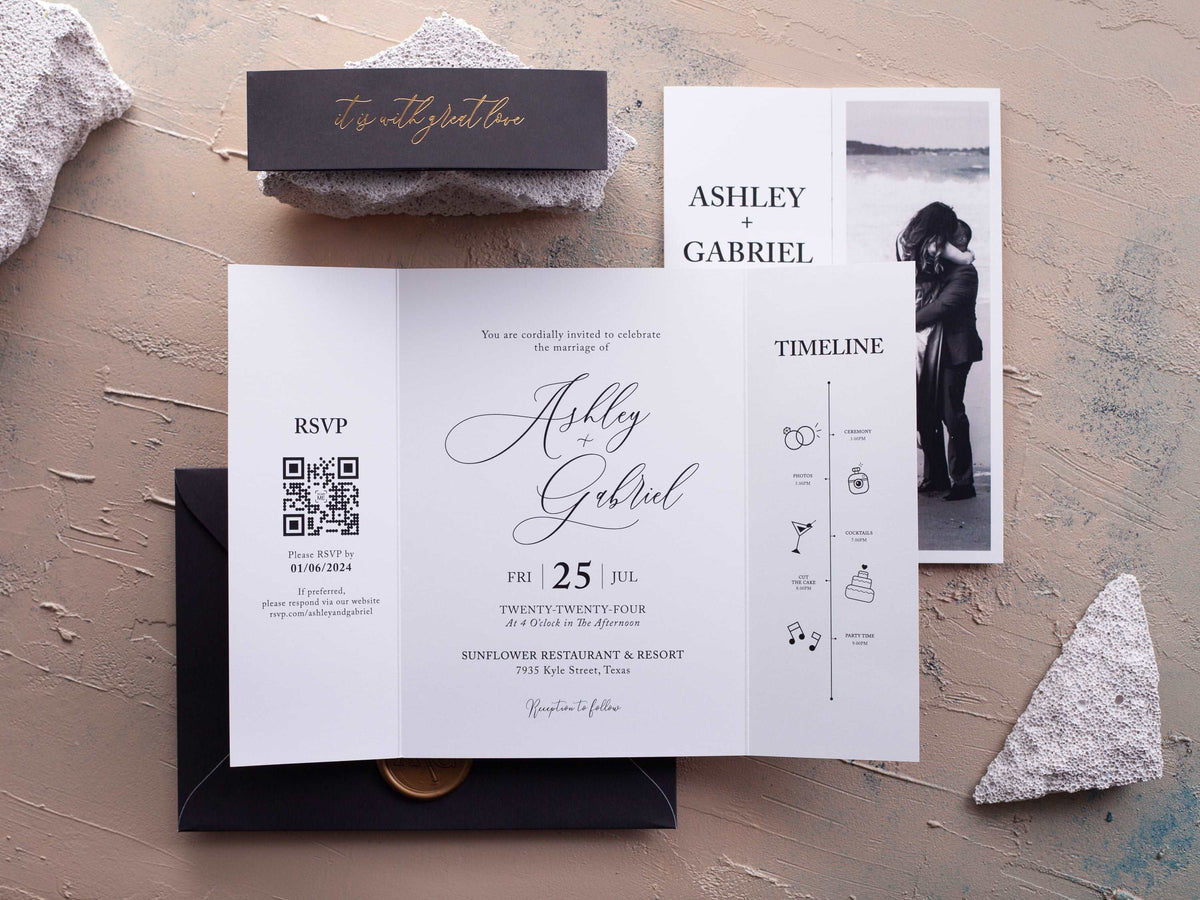
Folded wedding invitations give you room to guide guests through the celebration without turning the suite into a stack of separate cards. The format can hold the formal invitation, schedule, travel notes, response details, and a favorite photograph while keeping each element in a clear place.
The best result is not the design with the most folds. It is the one that matches your information, opens intuitively, and remains easy to read from the first panel to the last.
In short: folded wedding invitations organize ceremony details, photos, timelines, or travel information across connected panels. Choose the fewest panels that fit your essential content, place the invitation message first, keep supporting details in reading order, and test the closed size before adding inserts, pockets, jackets, or closures.
What counts as a folded wedding invitation?
A folded invitation is any design that opens to reveal additional panels or layers. A simple bi-fold has one crease and two main interior areas. A trifold divides the piece into three connected sections. A gatefold brings two side flaps toward a center panel, while a folded jacket wraps around a separate card. Pocket formats add a compartment for inserts rather than relying only on printed panels.
The names describe construction, not a fixed visual style. Folded pieces can feel minimal, romantic, modern, or formal depending on the typography, materials, colors, and closure. Begin with the structure you need, then choose the surface design. Our folded wedding invitations collection brings several of these formats together for direct comparison.
Which folded format fits your amount of information?
List the information guests truly need before choosing a shape. A ceremony and reception at one venue may fit a bi-fold with the invitation on one side and practical notes on the other. A destination celebration may need three panels for the invitation, schedule, and travel guidance. A gatefold works well when you want a strong center message framed by supporting details on the side flaps.
Do not fill a larger format simply because space is available. Empty space improves hierarchy and makes important wording easier to find. If you have extensive accommodations, transportation, or weekend-event details, keep only the essentials on the invitation and direct guests to a wedding website. Compare trifold wedding invitations with gatefold wedding invitations to see how the same amount of information can be organized differently.

How should you order wording across the panels?
Think about what a guest sees at each stage of opening. The first main panel should carry the hosts, couple's names, date, time, and venue. Secondary panels can hold reception wording, dress guidance, schedule, travel, or response instructions. Keep related details together rather than making guests search across several flaps.
Use a consistent reading direction. Left to right is the safest choice for most English-language suites, but a gatefold can reveal a centered invitation first and then supporting information on the open sides. Use headings, spacing, and type size to show where one topic ends and the next begins. Before approving the design, print a rough mockup, fold it, and ask someone unfamiliar with the layout to read it.
When should you add photos, timelines, or maps?
Add a photo when it has a dedicated role, not simply because another panel is available. One strong engagement image can turn an interior panel into a keepsake. Avoid placing detailed wording over faces, patterned clothing, or a busy background. If the photograph is the emotional focus, let it occupy its own panel and keep names and logistics elsewhere.
A timeline is useful for multi-part days when guests need to understand the sequence at a glance. A simplified map can help when a venue is difficult to locate, but it should not replace a complete address or digital directions. Choose icons and labels that remain legible at the final printed size. Every visual element should reduce uncertainty rather than add decoration without purpose.
Do you need inserts with a folded invitation?
Often, no. The main advantage of a folded layout is that it can combine information that would otherwise require separate cards. Schedule, accommodations, transportation, website, and RSVP instructions can each occupy a clearly labeled area. This reduces loose pieces and gives guests one connected item to keep.
Inserts are still useful when a detail applies only to some guests, when a detachable response card is required, or when the invitation needs a physical direction card. A pocket can keep those pieces aligned without crowding the main panels. Explore pocket wedding invitations when your suite needs several removable components.

How do folded invitations affect envelopes and mailing?
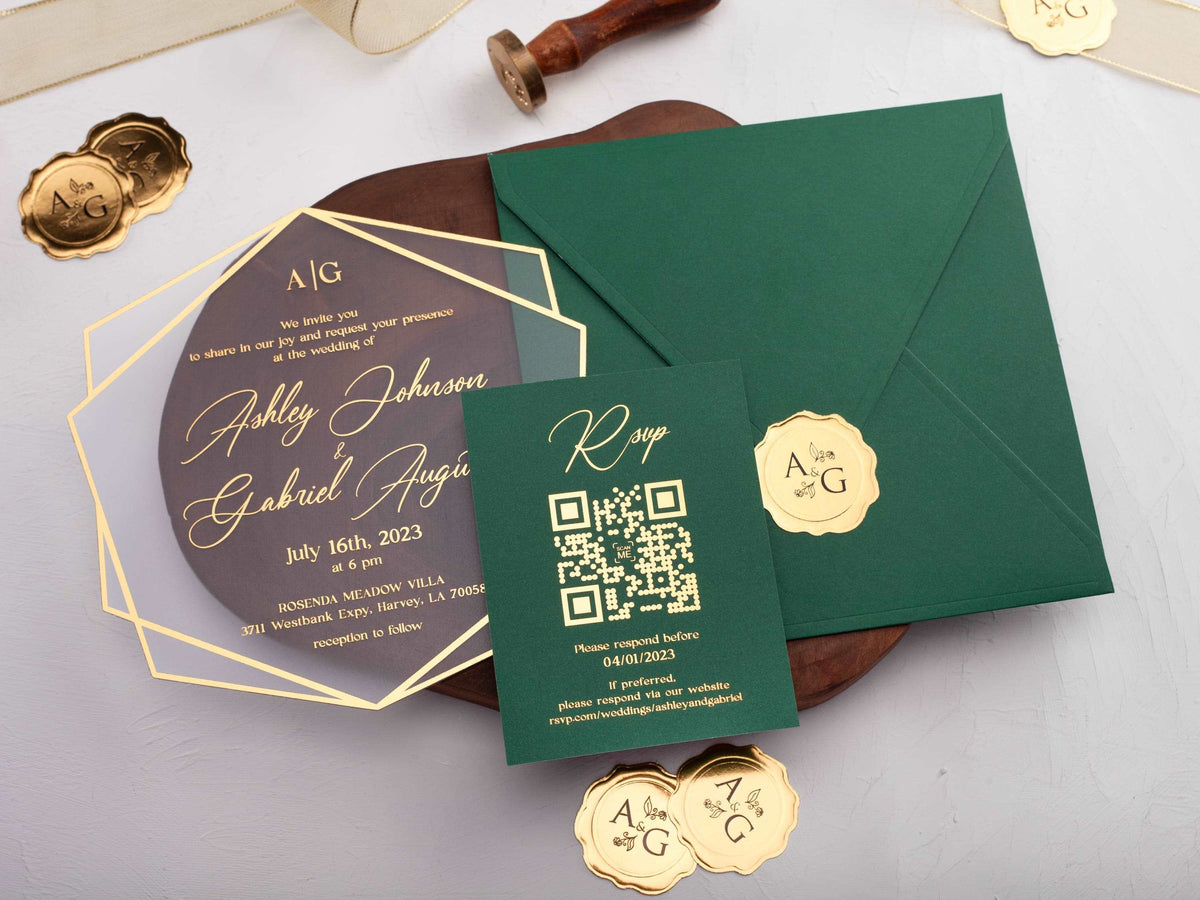
The closed size, thickness, weight, and shape determine how the suite mails. A design that looks compact when open may become bulky after adding an acrylic card, layered jacket, belly band, wax seal, or several inserts. Assemble one complete sample exactly as guests will receive it, then weigh and measure it before ordering postage.
Check that folds lie flat and do not press sharply against raised printing or delicate embellishments. An outer envelope can protect closures and keep a shaped invitation from catching during handling. If the final piece is rigid, square, unusually thick, or heavier than a standard letter, ask your postal service about the correct category and rate. Testing one finished suite prevents last-minute changes to envelopes or accessories.
Ready to compare panels, jackets, and all-in-one layouts? Explore our folded wedding invitations and choose the format that fits your details.
Frequently Asked Questions
Are folded wedding invitations more expensive to mail?
They can be if the finished piece is heavier, thicker, or outside standard postal dimensions, so test the complete suite first.
How many panels should a folded invitation have?
Use only enough panels for the invitation message and essential supporting details; two or three panels suit most suites.
Where should the main invitation wording appear?
Place it on the first main panel guests see after opening, with secondary information following in a natural reading order.
Can a folded invitation replace separate insert cards?
Yes. A well-planned folded layout can include schedule, travel, RSVP, or accommodation details without separate cards.
Are folded invitations suitable for photos?
Yes. Dedicate one panel to a strong image rather than placing text over a detailed photo.
What is the difference between gatefold and trifold invitations?
Gatefold invitations open from two side flaps toward a center panel, while trifold designs divide content across three connected sections.


Leave a comment
This site is protected by hCaptcha and the hCaptcha Privacy Policy and Terms of Service apply.