
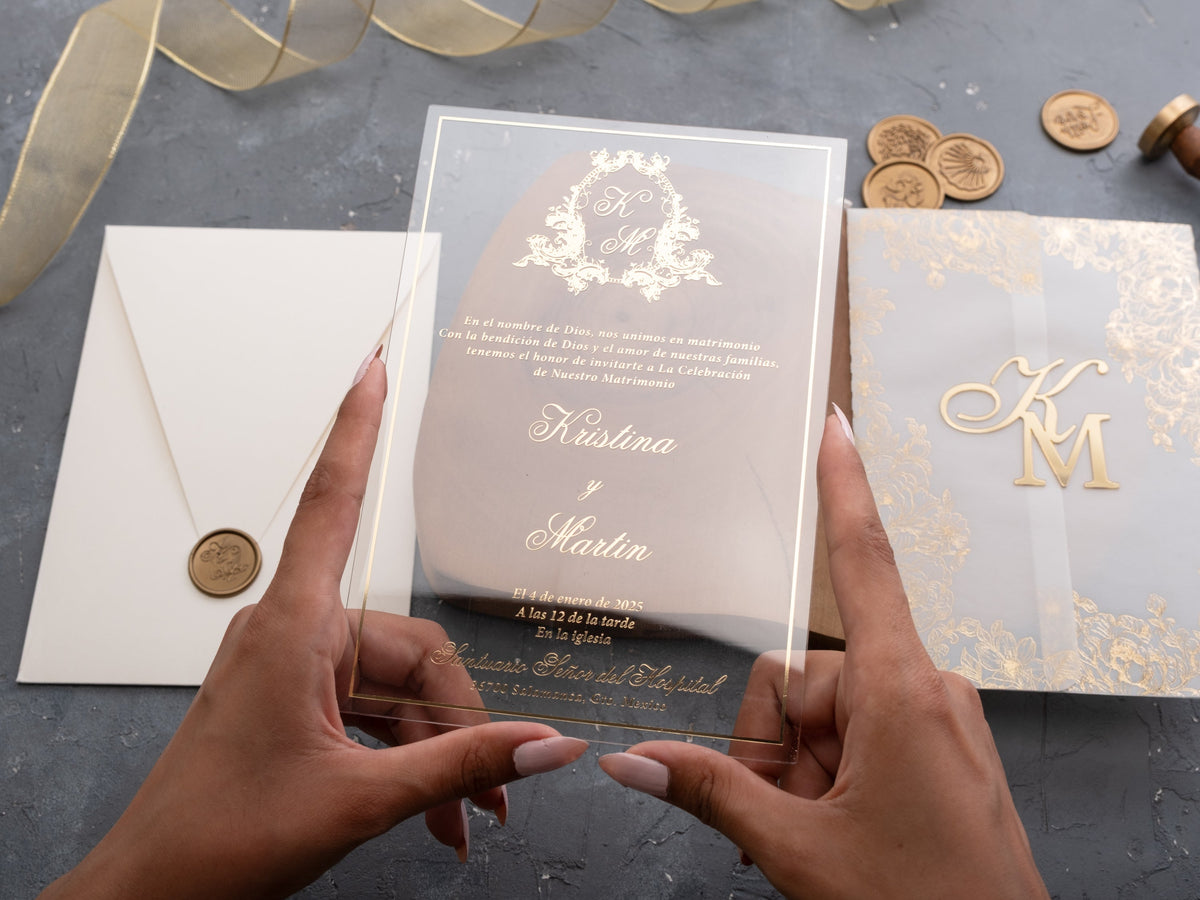
Vellum jacket wedding invitations give guests a first glimpse of your design before they open the translucent layer. That first impression can feel soft and deliberate, but the invitation still needs to be easy to read. This guide helps you decide what belongs on the jacket, what stays on the inner card, and how foil, paper, and acrylic can work together without crowding the message.
In short: Vellum jacket wedding invitations use a translucent outer layer to soften and frame the invitation beneath it. Keep essential wording on the inner card, limit printing on the jacket, and align decorative details so layers do not compete. Compare the design both closed and open before choosing paper or acrylic.
What is a vellum jacket wedding invitation?
A vellum jacket is a translucent outer layer that folds around the main invitation. It gives you two views to plan: the closed presentation and the invitation after opening. Some color, lettering, or decoration may show through the jacket, but that view should introduce the design rather than replace the readable inner card.
Think of the jacket as a frame. A simple monogram or small motif can make the closed invitation feel complete, while the card underneath carries the names, date, venue, and invitation message. The two layers should have different jobs. If both try to carry every detail, the result can look busy before the guest has even opened it.
Our vellum jacket wedding invitations collection includes complete layered designs, not just loose wraps. Compare the listing photographs and stated materials when choosing a format. A jacket can be paired with different inner cards, so check the individual listing rather than assuming every set uses the same material or includes the same pieces.
Which wording should stay on the inner invitation?
Keep the essential invitation message on the inner card. Guests should be able to find who is getting married, what they are invited to, when it happens, and where to go without reading through several overlapping layers. The jacket can provide a brief introduction, but it should not become the only place a key detail appears.
Start with a clear reading order. Your names or opening line can lead, followed by the date and ceremony location. Keep supporting information separate when it needs more room. A detailed schedule, travel note, or response instruction should not force you to shrink the main invitation wording until it is difficult to read.
Check the layout after opening, then check it closed. A word that reads well on the inner card may look fragmented through a fold or foil motif on the jacket. Move the inner text or simplify the outer decoration if the layers collide. Review the complete wording, including longer names and venue lines, rather than judging the layout from a short sample message alone.
How do foil initials work across translucent layers?
Foil initials give the jacket a focal point without asking it to carry the full invitation text. The clearest arrangement usually starts with one main detail: a monogram, a small border, or a restrained motif. Choose that detail first, then look at the card underneath to see whether the two layers support each other.
The Luxury Acrylic Wedding Invitation with Vellum Jacket and Foil Initials is a relevant example to compare when planning a clear card and gold foil presentation. Look at the relationship between the outer detail and inner wording, not just the amount of metallic decoration.

Keep important wording away from areas where the foil overlaps it in the closed view. Small text needs its own quiet space, especially when the material underneath is transparent. A larger initial can work as decoration, but it should not compete with the couple's names after opening. If you want matching metallic details elsewhere, compare foil printed wedding invitations while keeping the amount of decoration secondary to readability.
Does vellum pair better with paper or acrylic?
The better pairing depends on the look you want and how the wording reads. Paper gives the translucent jacket an opaque background. Acrylic can create a more see-through presentation. Neither material automatically makes the design clearer; the font, spacing, background, and placement of decoration still matter.
Compare paper wedding invitations if you prefer a solid card behind the jacket. Compare acrylic wedding invitations if the transparent inner layer is part of the effect you want. Judge the invitation against the surfaces guests may place it on, rather than only against the styled background in a product photograph.
A clear card may look different over a dark table, a patterned surface, or another insert. Keep small lettering well spaced and give the main message a distinct visual area. For either material, check the listing's stated card and jacket details before ordering. Do not assume a pictured envelope, seal, or extra insert is included. The complete set should make sense as a practical invitation as well as a coordinated design.
How can guests understand the opening order?
A layered invitation should make its next step feel natural. The closed view can introduce the couple, and the opened card can reveal the full message. Guests should not have to search through several loose pieces to work out which card they are meant to read first.
Place the main invitation where it becomes clear as the jacket opens. Keep supporting inserts together and avoid letting a smaller detail card cover the names or date. If the design uses a closure, review how it relates to the folds and the inner card. Check what the listing actually offers rather than assuming a ribbon or seal shown in styling is part of your order.
The Arabic Acrylic Wedding Invitation with Gold Foil Vellum Jacket provides another layered example. When comparing different lettering styles or longer messages, look for a clear distinction between the decorative first view and the readable card underneath. Keep that sequence consistent across the suite so extra information supports the invitation instead of interrupting it.

How do you keep layered invitations visually balanced?
Give each layer one clear role. The jacket can soften the first view, the inner card can carry the invitation wording, and any supporting insert can handle additional information. Repeating a small motif or finish can connect those pieces without covering every surface with the same decoration.
Begin with the essential text and leave space around it. Then add the outer detail. This makes it easier to notice when a border crosses a venue line or a monogram competes with the names. Keep the closed view calm enough to suggest what is underneath, while letting the opened card stand on its own.
Review the complete layout both ways before choosing your set. Check longer names, the final date format, and the full venue wording. Compare the jacket over the card rather than assessing each piece separately. If the design feels crowded, reducing one decorative element often helps more than making the type smaller. Explore our vellum jacket wedding invitations to compare complete layered designs with readable inner cards and restrained foil details.
What should you know before choosing vellum jacket invitations?
Is vellum the invitation card itself?
In a vellum jacket design, the translucent material usually forms an outer layer around the main invitation card.
Can guests read the wording through a vellum jacket?
Some details may remain visible, but the essential wording should be easy to read once the jacket is opened.
Should a vellum jacket carry the full invitation text?
A short monogram or decorative detail usually keeps the layers clearer; place the full message on the inner invitation.
Can vellum jackets be used with acrylic invitations?
Yes. The translucent layer can soften clear acrylic while leaving the main wording on the acrylic card.
How much foil should the jacket use?
Use foil selectively for initials, a border, or a small motif so it does not compete with the inner wording.
What should be checked before choosing a layered design?
Review the closed and open appearance, wording contrast, opening order, and the listing's stated materials and included pieces.

Leave a comment
This site is protected by hCaptcha and the hCaptcha Privacy Policy and Terms of Service apply.