
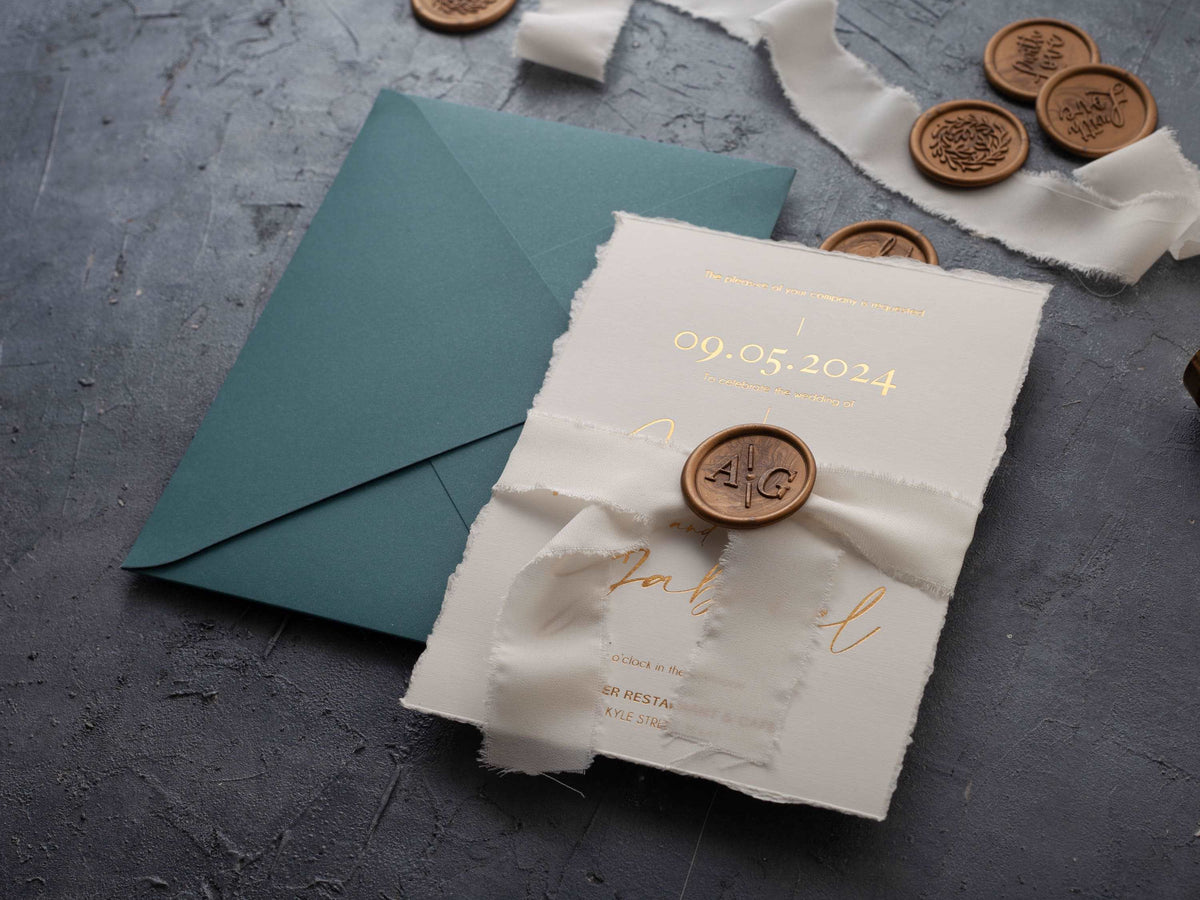
Deckled edge wedding invitations bring texture into the design before you add a color, border, or embellishment. Their irregular edges can feel relaxed and romantic, but they also work with a clean formal layout. Choosing the right paper, lettering, and format helps that tactile detail remain the focus. Here is how to compare the options and plan a suite that looks polished when it reaches your guests.
In short: Deckled edge wedding invitations use softly torn paper edges to create a tactile, handcrafted finish. Let the paper texture remain visible, choose typography with enough weight, and use foil or color as a focused accent. Coordinate envelope size and protective packaging before mailing to preserve the irregular edges.
What creates a genuine deckled edge?
A deckled edge is a soft, irregular paper edge rather than a perfectly straight cut. It can form during papermaking or be created afterward through controlled tearing or specialized tools. These methods do not produce identical results. Ask how the edge on your selected design is made if that distinction matters to you.
Look at both the shape and the surface. Some papers have a subtle waviness, while others show a stronger torn finish. Small variations are part of the visual effect, but the invitation still needs a balanced outline and enough usable space for the text. The edge should frame the message rather than make the card feel unfinished.
Browse deckled edge wedding invitations to compare how restrained and more pronounced edges change the mood. A genuine material sample helps you judge the texture better than a screen alone. Choose the degree of irregularity you enjoy, then build the typography and other details around that paper instead of treating the edge as a separate decoration.
Which paper weight works best for deckled invitations?
The best paper weight is the one that supports the chosen format and printing. A heavier flat card can feel substantial, while a folded piece needs a stock that bends cleanly. Weight alone does not tell you how smooth, flexible, or textured a sheet will be. Two papers with similar weights can behave differently.
Ask about the actual stock available for the design, including its surface and suitability for the planned printing. The minimal deckled edge invitation is a useful visual reference for allowing the paper and wording to do most of the work. Compare it with other paper wedding invitations rather than choosing from a weight number alone.
Consider the whole suite too. Multiple thick cards, a folded jacket, and a closure can create more bulk than expected. Request a sample or review a fully assembled version when possible. Check the envelope fit and finished weight before ordering the complete set, especially if you plan to include several supporting pieces.

How should typography be planned around irregular edges?
Leave a comfortable margin between the wording and the irregular edge. A border or line of text placed very close to a torn outline can make small variations look accidental. Keeping the main message slightly inward gives the paper room to show its character and protects the visual balance of the card.
Use type with enough weight for the chosen surface. A fine script may look attractive on a screen, but textured paper can reduce the clarity of very thin strokes. Reserve expressive lettering for names and use a clear companion font for the date, time, and venue. Open spacing can add elegance without adding another decorative element.
Review the layout at actual size rather than only in an enlarged preview. Read every practical detail, including the smallest line. If the wording feels crowded, simplify it or move supporting information to another piece. Do not shrink all the text to preserve a decorative border. The tactile edge is already a feature, so a quiet layout often gives it the strongest presentation.
Does foil printing work on deckled paper?
Foil can work beautifully with deckled paper when the stock and design support a clean impression. A reflective accent adds a different texture to the softer edge. Keep it focused on names, a monogram, or a restrained border rather than assuming that every line needs metallic treatment.
The deckled edge invitation with gold foil shows a warm metallic approach. Explore foil printed wedding invitations to compare how the amount of foil changes the overall effect. Confirm the printing method for the selected design, and ask to see how fine lettering appears on the actual paper surface.
Very textured paper and delicate strokes need particular care. A proof checks wording and placement, while a physical sample helps you judge reflection and the quality of the impression. Let the paper edge remain visible around the printed area. When both the texture and foil have a clear role, the suite can feel rich without needing several additional embellishments.
Which invitation formats suit deckled edges?
A flat card is the simplest way to show deckled edges because the outline remains visible at once. It suits a concise invitation message with supporting details kept elsewhere. A folded design offers more space for a schedule or guest information, but its paper and crease must work together so the finished piece closes neatly.
The trifold deckled edge invitation with gold foil illustrates how panels can carry a longer message while keeping a tactile finish. Decide what belongs on each panel before choosing the format. The formal invitation should be easy to find first, with practical information following in a clear order.
Compare a complete open and closed sample if possible. Irregular edges should align naturally without catching or creating unnecessary bulk. A jacket or ribbon can hold layers together, but each extra piece affects handling and mailing. Browse luxury wedding invitations for coordinated presentation ideas, then choose only the layers that give your own suite a useful purpose.

How can you protect deckled invitations during mailing?
Protecting deckled invitations starts with an envelope that fits the complete suite. The paper should slide in without the edges scraping or bending. Too little space can crush the irregular outline, while an oversized envelope allows the contents to move around. Test the fit with every insert and closure in place.
An outer envelope or protective sleeve may help when the edges are delicate or the suite includes raised details. Place embellishments so they do not press sharply into the paper. Store finished invitations flat and keep them dry before mailing. The aim is to preserve the surface you selected, not simply make the packaging look fuller.
Weigh and measure one fully assembled sample before choosing postage. Square shapes, thicker layers, and rigid additions can change how a piece is handled. Ask the relevant postal service about the finished suite rather than relying on a standard invitation estimate. A small test at this stage can prevent bent edges, poor envelope fit, and last-minute changes to the mailing plan.
Ready to compare tactile paper, metallic details, and refined formats? Explore our deckled edge wedding invitations and personalize your preferred design.
What else should you know before choosing your invitations?
Are deckled edges cut or torn by hand?
They can be handmade or produced with specialized tools, but the goal is a soft, irregular paper edge rather than a straight machine cut.
Is deckled paper suitable for small text?
Yes, when the paper surface is smooth enough and the typography uses practical sizes, weights, and spacing.
Can deckled invitations include gold foil?
Yes. Focus foil on names, monograms, or borders and test the impression on the selected paper before full production.
Do deckled invitations need an outer envelope?
An outer envelope or protective sleeve can help prevent delicate edges from bending or catching during postal handling.
Are deckled invitations only for rustic weddings?
No. Minimal typography, modern color, and restrained foil can make deckled paper suit contemporary, formal, or romantic celebrations.
Can a folded invitation have deckled edges?
Yes. The paper stock and fold must be tested together so the irregular edges align naturally without cracking or excessive bulk.


Leave a comment
This site is protected by hCaptcha and the hCaptcha Privacy Policy and Terms of Service apply.